Blue Ribbon Commission Bring Business Mindset to Education Debate
Thank you for joining us this Saturday morning.
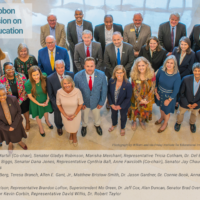
This week, the North Carolina Blue Ribbon Commission on Public Education held its inaugural meeting. The historic effort takes a business-minded approach to improving the public education system, with backing from Governor Josh Stein, Speaker Destin Hall, Senate Leader Phil Berger, together with the state’s business community.
Today, we dive into the commission’s charge and its early work.

***
The executive order establishing the commission outlines four – and only four – specific areas the commission may examine: teacher training and student advancement, administrative operations, educational leadership, and accountability.
It is not an exercise in digging deeper into the trench lines that defined the past decade’s education debates (i.e., teacher pay and Leandro). Rather, it is a serious effort by serious people to attack problem areas that may not attract sensational headlines, but have an enormous impact on delivering a public education.
“Improving education is not just about monetary investment,” co-chair Anne Faircloth said at the beginning of the commission’s first meeting this week. “It’s also about clear-eyed analysis about the results of our investments. The business community is excited to be part of this unique moment to look at K-12 education with fresh eyes.”
The commission counts among its membership a bipartisan who’s who of state government, business, and education leaders. Faircloth joins Dr. Don Martin, chair of the Forsyth County Board of Commissioners, as commission co-chair. UNC System President Peter Hans, Superintendent of Public Instruction Mo Green, Community College System President Dr. Jeff Cox, and Elon University President Dr. Connie Book sit on the commission as well. They’re joined by 10 members of the General Assembly and an array of business executives, teachers, and school board members.
The commission is employing a business-like structure and order to advance solutions for large, complex issues. They intend to tackle each of the four issue areas quarterly throughout the next year.
Upon the conclusion of its work, the commission will present proposed recommendations to the governor and legislators before the 2027 legislative session.
“We’re not wedded to specific programs or methodologies, but we do all bring skill and knowledge and commitment to the table,” Faircloth said. “I’m hopeful we can look at the complicated problems in a new light and come up with practical solutions.”
In a series of pieces in 2024, TRC Nexus outlined some of those underappreciated but no less impactful tenets of the public education system that seem ripe for examination.
In Part I, we untangled the history of North Carolina’s confusing education bureaucracy, in which both the State Board of Education and the Department of Public Instruction have jurisdiction over the school system. Many incentives drive the two to war, not work, with one another. North Carolina’s school children suffer because of it. Reform has been discussed publicly for 75 years, but, in many ways, still eludes policymakers.
In Part II, we explored the four main models other states employ to govern their public schools. We also discussed two examples of success – Mississippi and Massachusetts, which have both led in early childhood literacy reforms.
And in Part III, we looked at the reality that the public school system tries to be many things for many people, which is a recipe for falling short. “Enter a school and ask people with different titles what they believe the school offers its students, and you’ll get many answers that touch on family, social health, behavior, emotions, and, yes, learning,” we wrote. “Before we can begin to ask how to improve the public school system, we have to know why the public school system exists in the first place.”
The Blue Ribbon Commission arrives at a pivotal moment. North Carolina’s public schools face persistent challenges. Solutions may well be hiding in plain sight – they just require the right eyes to find them.
The commission’s remit – teacher pipelines, administrative redundancy, leadership development, accountability structures – may not fill campaign ads or drive protest marches. But they do determine whether a child in Robeson County gets an education that opens doors or closes them.
What distinguishes this commission from prior reform efforts is its mandate for practicality rather than political posturing. The four issue areas are bounded and tangible, and the membership is serious and cross-sectoral. The timeline – four quarters, four focus areas, and recommendations before the 2027 session – gives the commission structure and accountability.
Whether the commission delivers will depend on whether its members can resist the gravity of familiar arguments and stay focused on the harder, quieter work they’ve been asked to do. If a congregation of this caliber has been appointed to tackle a major policy issue at any time in the past, we’re not aware of it. With this commission, North Carolina may finally have the shrewd analysis its students have long deserved.
We’ll be watching so we can keep you informed as the commission’s work unfolds.
Recent Articles
How Wake Forest University Is Serving Those Who Served
Thank you for joining us this Saturday morning. It’s fair to assume that anybody who wore the uniform of one of America’s military branches would qualify as a “veteran” under the law. But that’s not what the law says: A less-than-honorable discharge can strip a former service member of all veteran benefits, including health care,…
The Political Center Is Getting Squeezed
Good Saturday morning and thank you for joining us. With a number of primaries completed (46 by our count) we’re taking a look at some of the political trends emerging from this year’s primary season, and what they may tell us about where both parties are headed. American politics has always had its factions. We think…
Amid a Turbulent Media Environment, TRC Nexus Stands Alone
From the Desk of Mike Rusher Thank you for joining us this Saturday morning. A week ago, the Nexus team sat down to review our performance for the year and get a better sense of which topics and stories are resonating most with C-suites across the state. The timing was good: our latest TRC Nexus…