
North Carolina’s emerging senior demographic challenge
Thank you for joining us this morning. Advances in medical care combined with declines in the birth rate mean North Carolina’s population is, on average, getting older. A higher number of residents over 65, 75, even 90 presents challenges for government budgets, particularly Social Security and Medicare.
But it also presents another problem: Where will they live? We’ll dive right in.
***
Both the raw number and the proportion of Americans entering their golden years is reaching never-before-seen levels. The supply of senior-focused housing is struggling to keep pace.
“We’ve never had a population pyramid that looks like this,” Arick Morton, CEO of data consultancy NIC MAP, told the Wall Street Journal. “The senior housing industry would need to develop twice as many units as it has ever developed in any single calendar year every year to keep up.”
The Journal estimates “more than 560,000 new units are needed to meet all the demand by 2030, but only 191,000 will be added at current development rates.”
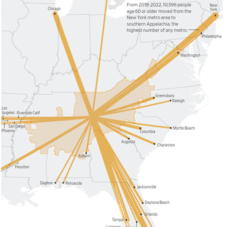
North Carolina in particular faces a housing supply crisis across the board. Projected growth in the state’s 65+ population suggests demand for senior housing will accelerate, and retirees are increasingly migrating to sections of Georgia, North Carolina, and Alabama in lieu of traditional destinations like Florida.
The retirement-age population in Brunswick County, for example, grew by 54% between 2011 and 2021, according to the Triangle Business Journal. Appalachia, too, is becoming an attractive destination for seniors.

Data Visualization: Wall Street Journal
The North Carolina Department of Health and Human Services reckons that the number of North Carolinians under 60 will increase by 12-17% by 2040. But the department expects the number of people over 60 to increase by 40%, the number of people over 65 to increase by 52%, and the number of people over 85 to increase by an astounding 116%.
The number of people over 65 years old will likely eclipse the number of children under 18 in North Carolina by 2031.
But market dynamics, at least right now, do not seem favorable for senior-focused housing supply to catch up to demand.
A combination of low interest rates and impending Baby Boomer retirements in the 2010s primed developers to overbuild senior housing communities, broadly speaking. Then the pandemic eviscerated demand, leaving many developments in precarious financial positions and prompting some to shut down. New supply has not rebounded, and many developers just hope existing senior living centers return to pre-pandemic occupancy rates.
Senior Housing News, an industry publication, summed up the sentiment: “The industry is heading into the new year with more momentum on occupancy and the prospect of regaining pre-pandemic census levels by the year’s end. At the same time, they are excited by a relatively low rate of new construction starts and looming demand from the baby boomer generation, which could keep occupancy gains flowing into 2025 and potentially beyond.”
Currently, many, not all, developers are focusing first on new construction that caters wealthy retirees who can afford luxury communities, according to the Wall Street Journal.
Some modest senior-centric housing units have moved forward in North Carolina. A 62-and-up apartment community in Durham, for example, broke ground last year. But it received funding from a combination of city grants, loans, and corporate philanthropic contributions.
Add it all together and North Carolina, like the rest of the country, is staring down a special type of housing supply crisis. If current trends continue, seniors – especially those on fixed incomes – will not have access to housing that can accommodate the needs of an aging population. Pricing and financing the housing supply for middle-income retirees is currently hindering growth in this space, and that’s before accounting for the labor shortages plaguing the health care workforce.
Many question: Will the market return to some sort of equilibrium?
In the meantime, we need a serious look at the policies that help, or hinder, industry leaders that are dedicated to helping house our state’s seniors. More to come on this in the future.
Recent Articles
How Wake Forest University Is Serving Those Who Served
Thank you for joining us this Saturday morning. It’s fair to assume that anybody who wore the uniform of one of America’s military branches would qualify as a “veteran” under the law. But that’s not what the law says: A less-than-honorable discharge can strip a former service member of all veteran benefits, including health care,…
The Political Center Is Getting Squeezed
Good Saturday morning and thank you for joining us. With a number of primaries completed (46 by our count) we’re taking a look at some of the political trends emerging from this year’s primary season, and what they may tell us about where both parties are headed. American politics has always had its factions. We think…
Amid a Turbulent Media Environment, TRC Nexus Stands Alone
From the Desk of Mike Rusher Thank you for joining us this Saturday morning. A week ago, the Nexus team sat down to review our performance for the year and get a better sense of which topics and stories are resonating most with C-suites across the state. The timing was good: our latest TRC Nexus…