American’s distrust in the media continues
Thanks for joining us this Saturday morning.
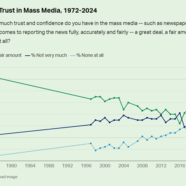
This month, Gallup released its annual survey of trust in American institutions. For the seventh consecutive year, the proportion of respondents who have a “great deal/fair amount” of trust in the media dropped. The figure now sits at just 31%, tied for the record low hit in 2016. Trust in media was lower than trust in every other institution measured, including Congress.
What does this mean for American politics and society generally? And what might be driving it? We’ll talk about that and more below.

Source: Gallup
***
How could that many people really support [insert political figure you don’t like here]?
Part of the answer is bona fide ideological differences. Deep partisans often can’t grasp why other people might see the world so differently from them. Politics, for some, really is that black and white.
But another part of the answer, we suspect, is staring at us in the graph above. Less than one-third of Americans trust what they read in the newspaper or hear on the news. Information that might have been disqualifying for a candidate a generation ago (remember when plagiarism allegations sank Joe Biden’s 1988 campaign for president?) often prompts only a minor change in voter attitudes now, if any at all. That’s because many people just don’t believe it.
The dynamic is part and parcel to hardening polarization. People have their camps. They trust only what people and news outlets inside that camp tell them, and they ignore everybody else. Elected officials and party operatives certainly bear some responsibility for this. They leverage the disaffection and often try to motivate their own voters by throwing yet more fuel on the fire.
But the media industry itself also bears a healthy portion of the blame. Many of the complaints from partisans about media behavior have turned out to be true. Examples range from purported Trump/Russia collusion to COVID’s origins to President Joe Biden’s mental acuity to Black Lives Matter protests and the attendant fallout. Major media blunders build on one another – each new example convinces yet more people that they shouldn’t trust what journalists tell them.
What’s more, an increasing proportion of coverage in mainstream news outlets is funded by activist organizations. Coverage of climate change in North Carolina, for example, is funded by a climate activist group called the Green South Foundation. Crime coverage is funded by a criminal justice activist organization, whose slogan is “Powering Reform Everywhere.” A thriving new startup which doesn’t reveal its funders, receives funding from donor organizations backed by George Soros. In these cases, subscription models and newspaper sales don’t provide sufficient revenue to maintain or properly support a media outlet – so outside funding is attractive to support operational budgets (though each will say that funders have no influence over content).
Is it possible these activist organizations spend millions of dollars to fund media coverage purely out of the goodness of their hearts? Sure, it’s possible. Whether many people would believe that is another matter – It is up to the outlets to prove they are capable of operating without influence.
***
TRC Nexus exists, in part, as a foil to this phenomenon. We are not a money-making operation. We offer this executive to executive product as a service to North Carolina’s business community to call things like we see them. We get things wrong on occasion, and when we do we’re up-front about it. That’s how organizations build trust – by sticking to their narrow mission, operating transparently, and staying true to their purpose.
Thank you for reading.
Recent Articles
How Wake Forest University Is Serving Those Who Served
Thank you for joining us this Saturday morning. It’s fair to assume that anybody who wore the uniform of one of America’s military branches would qualify as a “veteran” under the law. But that’s not what the law says: A less-than-honorable discharge can strip a former service member of all veteran benefits, including health care,…
The Political Center Is Getting Squeezed
Good Saturday morning and thank you for joining us. With a number of primaries completed (46 by our count) we’re taking a look at some of the political trends emerging from this year’s primary season, and what they may tell us about where both parties are headed. American politics has always had its factions. We think…
Amid a Turbulent Media Environment, TRC Nexus Stands Alone
From the Desk of Mike Rusher Thank you for joining us this Saturday morning. A week ago, the Nexus team sat down to review our performance for the year and get a better sense of which topics and stories are resonating most with C-suites across the state. The timing was good: our latest TRC Nexus…