
Reading the tea leaves in the early voting data
From the Desk of Mike Rusher, President, The Results Company
Thanks for joining us this Saturday morning, the last day of early voting. Pardon the late delivery, we have some fresh data that is not yet available anywhere, so here is an absolute exclusive for TRC Nexus readers.
Today we’re breaking down the trends and numbers from an early voting period that’s been unlike any other in North Carolina history. I’ve had the opportunity to track and report on early vote performance in this state for the last 15 or so years, and the privilege of advising some incredible people over that timeframe.
North Carolina is unique in not only is abnormally long period of early voting, but the way they report early voting data. Each morning, around 5:30am, the state elections board publishes who voted by mail and at a one-stop site from the previous day. This data can be compiled and compared to past elections. What is revealed after that, provides incredible insight into what’s happening. That’s why in mid October, every year, I stop paying attention to polls in North Carolina – this year, 70% of all votes will have come in before election day, and few pollsters have figured out how to navigate that environment.
Before I digress further, let’s get right to it.
***
Topline Numbers
4.175 million votes have been cast early as of this morning, a number that will of course increase slightly after today. That represents 53.6%all registered voters in North Carolina.
Most casual observers of North Carolina politics know by now that Democrats always turn out their voters in higher numbers during early voting, while Republicans turn out in force on Election Day.
Well, that’s no longer true. This election cycle, more Republicans voted early than Democrats. As of all votes in (mail + one-stop) at close of polls on Nov. 1st – here is the breakdown:
- Democrats total 1.351 million. At this point in 2020, they totaled 1.644 million.
- Republicans total 1.403 million. At this point in 2020 they had 1.390 million.
- Unaffiliateds total 1.392 million. At this point in 2020 they had 1.322 million.
This result turns conventional political wisdom on its head. It is unprecedented.
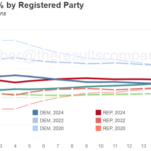
Republicans have indeed voted in slightly higher numbers this year than in years past, but the real issue has been Democratic turnout. At this point in 2020, Democrats represented 32.6% of the early vote share. That means Democrats are behind their 2020 numbers by 5.1%, translating to nearly 300,000 raw votes. Here’s that data, charted, on a daily cumulative vote tracker:

By way of comparison, Donald Trump won North Carolina by 74,000 votes in 2020.
Age and Gender
An oft-repeated storyline in early voting states this year is that women are outperforming men. That’s true, but they’re not outperforming men at a level that’s all that different from previous elections. It’s also not a statistic that can reliably infer final election results (more on that below).
The 2024 early voting electorate is 51.8% female and 41.3% male. In 2020, the early voting electorate at this point was 51.5% female, and 40.8% male. The 2024 female voting advantage is half a percent less than it was in 2020.
Age is a slightly different story. The early voting electorate is older this year than it was in 2020. This, to me, is the second most important data set (only to partisan performance) of 2024 early voting. The 65+ block and the 45 – 65 block make up 67% of the 2024 early voters, and the 65+ block continues to overperform – it is the only age block that has increased its share of the voting electorate since 2020.
For 65+ voters, They currently make up 31% of the voting electorate (1.285 million votes), this is a 4.2% increase over 2020. The youths (18-30) now own 14.4% of the electorate so far, (599k) and have fallen 1.1% below where they were in 2020.
Here’s what that data looks like in text and then charted on the daily cumulative vote tracker .
Age turnout block summary (compared to 2020)
65+: 31% (+4.2%)
45-65: 36.9% (-1.7%)
31-44: 17.7% (-1.4%)
18-30: 14.4% (-1.1%)

***
So, what does it all mean? You’ll get no predictions this morning, but you will be hard pressed to find data points that suggest Democrats are in good position heading into election day.
According to all available data, Democrats in North Carolina have given up significant ground in terms of their share of the electorate and their raw vote performance – forcing dependance on an abnormally good election day. Democrats have slipped notably with key voting blocks, (both raw votes and percentage share), key age groups, Black voters, the gender gap (which I only point out because it was hijacked as a partisan talker), and they have so far underperformed in urban counties. So all eyes shift to the Unaffiliated voters – and election day.
As a result of this Democratic underperformance, some key narratives have formed that are worth examining.
- Narrative 1: “Republicans are cannibalizing their votes, and just voting earlier this year” – The data shows that Republicans have shifted about 9% of 2020 election day voters to 2024 early voting, while Democrats have shifted about 5%. The delta between the two is 40k-50k voters.
- Narrative 2: “Democrats will come out during closing arguments” – This is certainly a possibility during today’s voting, and perhaps on election day. However, students of election statistics in the Old North State would look for this trend to have already revealed itself, at least in part, during early voting – which would provide for some kind of consistency to compare to any previous election data trends.
- Narrative 3: “The Unaffiliateds are breaking heavily towards Democrats” – Perhaps the strongest of the three, though when looking at partisan preferences among this block, a slight shift in Unaffiliateds partisan preference doesn’t make up yet for what appears to be an incredible underperforming Democratic voter base. This is again, based on data trends from ’22, ”20, ’18, ’16, ’14, ’12, and 2010.
- Translation: Unaffiliated splits have not deviated too far from partisan performance trends over the last 7 cycles, but it’s not out of the realm of possibility.
We of course do not know what Election Day turnout will be, but I do estimate with near certainty there will be between 1.5 and 1.6 million voters on election day.
It’s tempting to look at these numbers and conclude North Carolina Republicans are in for a big night on Tuesday, but North Carolina has shown a history of election day surprises. . .
The closest we can get is this: By all measures, Republicans are better positioned than Democrats heading into election day, and the numbers have caused significant concern to Democrat candidates (unless they have been consistently up by double digits in the polls this cycle) and operatives, publicly and privately.
For those of you that are looking to temper expectations on either side, let’s share a moment with election guru Nate Silver, who is probably the most-watched political statistician in the world right now, who put it this way:
“Early vote analysis tends to be the province of partisans on both sides who also dive into crosstabs and “unskew” polls and get upset if every single data point doesn’t bear good news for their party. The commonality is that there are too many floating parameters — too many ways to cherry-pick to tell yourself the narrative you like. Invariably, the data looks relatively good for Republicans in some states but decent for Democrats in others. The comparison points aren’t obvious: should we be looking at the trend since 2020? The trend since 2016 because 2020 was a COVID year? The absolute numbers, treating the early vote as though it were a poll. . .?”
We’ll be out Tuesday with what to watch and of course Wednesday with the results.
Thank you for reading, and feel free to share this update and contact me at mrusher@theresultscompany.com with questions.
Recent Articles
How Wake Forest University Is Serving Those Who Served
Thank you for joining us this Saturday morning. It’s fair to assume that anybody who wore the uniform of one of America’s military branches would qualify as a “veteran” under the law. But that’s not what the law says: A less-than-honorable discharge can strip a former service member of all veteran benefits, including health care,…
The Political Center Is Getting Squeezed
Good Saturday morning and thank you for joining us. With a number of primaries completed (46 by our count) we’re taking a look at some of the political trends emerging from this year’s primary season, and what they may tell us about where both parties are headed. American politics has always had its factions. We think…
Amid a Turbulent Media Environment, TRC Nexus Stands Alone
From the Desk of Mike Rusher Thank you for joining us this Saturday morning. A week ago, the Nexus team sat down to review our performance for the year and get a better sense of which topics and stories are resonating most with C-suites across the state. The timing was good: our latest TRC Nexus…