
Understanding the UNC Board of Governors’ new policy on DEI
Thank you for joining us this Saturday morning. Last month, a committee of the UNC Board of Governors advanced a new policy taking aim at “diversity, equity, and inclusion” (DEI) policies in the UNC System.
This topic is fraught with sensitivities, confusion, and misunderstanding. Today, we’ll unpack it. Regardless of your position on DEI policies, you’ll at least be equipped with the knowledge of what the Board of Governors policy does, and what it doesn’t do.
***
First, what is DEI really?
Like most vague and complex topics, it depends on who you ask. Advocates for DEI policies suggest they’re long-overdue efforts to focus on an organization’s racial and gender diversity, and to make members of historically marginalized groups feel more welcome.
Opponents of DEI policies say that sentiment is all well and good, but simple notions of “diversity” and “inclusion” are not what DEI policies actually advance. They point – convincingly, in some instances – to examples of eyebrow-raising DEI policies in practice. For example, some companies and universities require job applicants to sign statements that pledge agreement to concepts like “antiracism,” which is a fraught and controversial ideology that centers on the notion that it’s okay to discriminate on the basis of race today to make up for discrimination that happened long ago. NC State University required such statements until the Board of Governors banned the practice.
As another example, a K-12 teacher training regimen at UNC-Chapel Hill reflects the extreme ends of DEI-infused programs. Its curriculum asserts “colorblindness [is] a rhetorical tool to prop up white supremacist ideals,” and that “it’s never too early to begin talking about race with children in the library.”
Such examples may not reflect the intentions of some DEI advocates, but it’s indisputable that they exist. It’s those types of programs and policies that DEI opponents hope to unwind from institutional embrace.
***
Second, what exactly did the Board of Governors do as it relates to DEI?
The full Board of Governors hasn’t taken action yet, but it appears very likely they will adopt at their next meeting a proposed policy that advanced out of a Board of Governors committee in April.
Put simply, that policy prohibits UNC System institutions – not faculty or course materials – from promoting or furthering a list of 13 concepts associated with the more extreme types of DEI doctrine.
That list is already contained in a state law having to do with executive agencies and employees. Concepts included on the list are:
- “One race or sex is inherently superior to another race or sex.”
- “Particular character traits, values, moral or ethical codes, privileges, or beliefs should be ascribed to a race or sex or to an individual because of the individual’s race or sex.”
- “A meritocracy is inherently racist or sexist.”
The prohibition on promoting or furthering those concepts extends to “university-led student orientations, training, or activities.” It also prohibits universities from maintaining staff or offices for the purpose of advancing any of the listed concepts: “No employing subdivision or employment position within the University shall be organized, be operated, speak on behalf of the University, or contract with third parties to provide training or consulting services” regarding the concepts.
The proposed policy makes clear that the restrictions do not apply to “faculty’s pursuit of teaching, research, and service.”
***
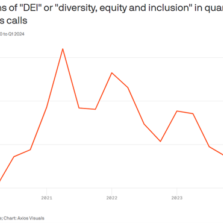
The DEI movement entered corporate America and academia rapidly during the 2020 unrest that gripped the country, and it appears to be unraveling just as quickly. This Axios chart tells the story:

;
Johnny Taylor, president of the Society for Human Resources Management, told Axios: “The backlash is real. And I mean, in ways that I’ve actually never seen it before. . .CEOs are literally putting the brakes on this DEI work that was running strong” since the 2020 unrest.
Notions of diversity and acceptance enjoy broad agreement. But extreme iterations of DEI work have poisoned the well, and in some cases have taken hold of the entire movement. The letter and spirit of the Board of Governors policy does not attack the principle of diversity as it has long been understood. Rather, the policy references concepts that, we think, most people would find objectionable, and it prohibits universities as institutions from embracing them.
If, while you were reading, another executive came to your mind that could find this analysis valuable – please forward it to them and encourage them to click the sign up button below to subscribe to TRC Nexus. Thank you for reading.
Recent Articles
How Wake Forest University Is Serving Those Who Served
Thank you for joining us this Saturday morning. It’s fair to assume that anybody who wore the uniform of one of America’s military branches would qualify as a “veteran” under the law. But that’s not what the law says: A less-than-honorable discharge can strip a former service member of all veteran benefits, including health care,…
The Political Center Is Getting Squeezed
Good Saturday morning and thank you for joining us. With a number of primaries completed (46 by our count) we’re taking a look at some of the political trends emerging from this year’s primary season, and what they may tell us about where both parties are headed. American politics has always had its factions. We think…
Amid a Turbulent Media Environment, TRC Nexus Stands Alone
From the Desk of Mike Rusher Thank you for joining us this Saturday morning. A week ago, the Nexus team sat down to review our performance for the year and get a better sense of which topics and stories are resonating most with C-suites across the state. The timing was good: our latest TRC Nexus…