Redistricting views skewed by zero-sum outcomes
October 7th, 2023
For most of you reading this, it’s Saturday morning. Put down your coffee and look out the window. It’s October, so you’ll likely see squirrels scampering about burying nuts to excavate during the lean winter months.
Stay in that spot for the next twelve weeks and you’ll likely see birds digging up the nuts and eating them.
Is that fair? Probably not from the squirrel’s perspective. But to the bird, which may starve absent the ill-gotten nuts, it’s a question of survival.
In this case, no objective definition of fair exists.
Sure, you can make reasoned arguments for one side or the other – appeal to Locke’s labor theory of property in defending the squirrel, or maybe Hobbes’ state of nature (“nasty, brutish, and short”) in defending the bird.
But in a zero-sum environment, like animals fighting over finite food, any outcome advantages one side and disadvantages the other. There is no middle ground, and therefore no possibility of agreeing on whether an outcome is “fair.”
So it is with redistricting in a representative democracy.
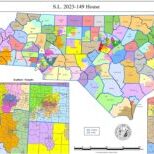
Senate Leader Phil Berger told reporters that the legislature may begin voting on new districts as early as this week.
We’ve written previously about the complex legal history that got us here. We won’t rehash all the details aside from a brief summary. Instead, we’re offering today an argument for why the redistricting question will never reach a satisfactory resolution. That’s because redistricting is a zero-sum exercise, and arguments about what’s “fair” depend entirely on which side an outcome advantages.
***
Why is North Carolina drawing maps again? In 2022, the state Supreme Court ruled that districts drawn in 2021 violated the state Constitution because they advantaged one political party over another.
The justices cited several mathematical formulas analyzing partisan breakdowns of the districts when concluding the maps weren’t “fair.” But the justices didn’t tell legislators exactly which of the formulas they should use when drawing maps in the future, nor did they give much clarity about what mathematical results would be acceptable or not.
Lawyers for legislative leaders wrote, “Only the four members of the [Supreme Court] majority can or will know a gerrymander when they see it; everyone else must await their Delphic pronouncement.”
Earlier this year, legislative leaders petitioned the Supreme Court for a rehearing on the subject. The Court’s new majority granted the rehearing and ruled that questions about partisan outcomes in redistricting aren’t for the judiciary to decide. Chief Justice Paul Newby wrote, “Choosing political winners and losers creates a perception that courts are another political branch.”
The same ping-pong match has played out in North Carolina since the 1980s. All of the controversy centers on whether a certain set of maps is fair or unfair.
But, like the squirrel and the bird, no objective definition of fair can possibly exist in redistricting. Given a choice between two map configurations, one will always advantage one political party over another. There is no middle ground.
THERE IS NO UNBIASED ARBITER OF FAIRNESS
Who, then, decides which political party to favor? Some want the judiciary to decide. But the judiciary interprets existing laws, it doesn’t invent new ones. And right now, no law exists for the judiciary to apply. In the name of “protecting democracy,” then, some advocates would have the judicial branch ignore the its constitutional mandate. That doesn’t seem prudent.
What’s more, when the supposedly impartial justices who decide redistricting outcomes were themselves litigants for pro-Democratic Party organizations in redistricting lawsuits – like Justice Anita Earls and Justice Allison Riggs – they don’t engender much trust.
Others point to an “independent redistricting commission” as the answer. But that doesn’t solve the problem of maps advantaging one party over another, it just transfers authority for deciding who to favor from the legislature to a commission.
One rationale for an “independent redistricting commission” argues that its members would be less political than legislators. Really? It seems fanciful to presume that the single most important political process – determining political boundaries – could somehow be conducted without any attention to politics.
There is no unbiased arbiter of fairness.
BENCHMARKING MAPS TO OBJECTIVE PARTISAN MEASUREMENTS ISN’T FAIR, EITHER
If no neutral map-drawing arbiter exists, then perhaps fairness can be achieved by pegging district electoral outcomes to some objective standard, like an average of recent statewide election results.
That’s a natural position to hold, but consider the implications of putting that into practice. Say, for example, North Carolina must have eight Republican congressional districts and six Democratic districts because that roughly resembles recent statewide election results.
Map-makers must then draw lines to predetermine the electoral outcome of each district – the exact practice that reformers wish to abolish. What’s more, drawing six Democratic districts in our geography would require ignoring county lines and pairing agricultural communities with urban centers. Is that fair?
Another objective measurement bandied about by academics is to compare the partisan breakdown of a set of maps to all other possible map configurations. The output of that exercise is something like, “These maps result in more Republicans elected to Congress than 92% of all other possible maps.”
The algorithms that produce these types of analyses are only understood by a handful of PhDs and therefore ripe for manipulation, but let’s set that aside for a moment. If this standard is used to judge fairness, then what’s the cutoff – maps must be within the 75th percentile of partisanship? The 80th percentile? And who decides? The decision points quickly become arbitrary and unworkable.
OBJECTIVE CRITERIA ARE THE ONLY WAY TO COME CLOSE TO “FAIRNESS”
Picking map-makers and picking map outcomes don’t come any closer to solving the “fairness” question.
Process seems the only other consideration. Before the past decade’s flurry of partisan gerrymandering litigation, North Carolina had actually settled into something of a redistricting sweet spot.
Two state Supreme Court redistricting decisions (called the Stephenson decisions) in the early 2000s set forth particular criteria legislators must follow when drawing districts, and none of them had much to do with partisan outcomes.
Those criteria had to do mostly with geography and avoiding the ugly, meandering districts that many associate with gerrymandering. Legislative districts must keep counties whole if possible, for instance, and must minimize the number of county line traversals. Legislators have also added additional criteria in the past, like not splitting municipalities when possible and adhering to geometric ratios that keep districts compact.
Objective criteria like this center the question of fairness on process, not authors or outcomes. Yes, lawmakers following this kind of criteria have more latitude to make decisions motivated by politics than if they followed criteria pegged to outcomes. But they’re still boxed in – process criteria limits partisan outcomes because it limits the universe of possible configurations.
In a zero-sum environment, no outcome-oriented definition of fairness will ever find broad agreement. Reformers, to the extent they’re truly interested in a better process instead of just advantaging their preferred political party, would do well to focus their attention on process instead. They just might find a more receptive audience.
Recent Articles
How Wake Forest University Is Serving Those Who Served
Thank you for joining us this Saturday morning. It’s fair to assume that anybody who wore the uniform of one of America’s military branches would qualify as a “veteran” under the law. But that’s not what the law says: A less-than-honorable discharge can strip a former service member of all veteran benefits, including health care,…
The Political Center Is Getting Squeezed
Good Saturday morning and thank you for joining us. With a number of primaries completed (46 by our count) we’re taking a look at some of the political trends emerging from this year’s primary season, and what they may tell us about where both parties are headed. American politics has always had its factions. We think…
Amid a Turbulent Media Environment, TRC Nexus Stands Alone
From the Desk of Mike Rusher Thank you for joining us this Saturday morning. A week ago, the Nexus team sat down to review our performance for the year and get a better sense of which topics and stories are resonating most with C-suites across the state. The timing was good: our latest TRC Nexus…