

Passenger rail’s future in North Carolina
Thank you for joining us this Saturday morning.
America once led the world in train travel. Routes spanned the continent and most people had easy access to a train station. But trains gave way to cars and planes, and by the 1960s privately owned train companies were bleeding revenue.
In 1970, Congress passed and President Richard Nixon signed the Rail Passenger Service Act, which created government-owned Amtrak and “removed the requirement that private rail companies provide passenger service,” according to CNN.
Today, there is only one privately owned intercity passenger railroad – Brightline, which operates between Miami and Orlando. Most privately run rail traffic is freight, and 70% of the tracks Amtrak uses for passenger service are owned by freight companies, CNN reported. That means Amtrak trains often face delays as they wait for freight traffic to clear.
“On-time” performance figures for Amtrak and state-backed rail service in North Carolina do not inspire confidence. In the first quarter of fiscal year 2024, the Carolinian – which terminates in Charlotte and has stops throughout North Carolina – had just 67% on-time performance. Only 47% of customers deboarding in Charlotte exited the train on time.
It is difficult to attract consistent ridership when arriving on time is a coin flip.
***
Still, hope remains. North Carolina’s population centers are growing, and ridership figures for the first half of 2024 broke records. Tickets for a special train to the U.S. Open golf tournament in Pinehurst sold out rapidly. Demand for convenient rail travel clearly exists.
And in the past year, federal funding announcements for new North Carolina rail projects has rejuvenated conversations about expanded and reliable passenger rail.
In December 2023, the Biden administration announced a $1.1 billion grant to improve rail service between North Carolina and Virginia. According to Gov. Roy Cooper’s office, the grant “will be used to complete the initial phase of the Raleigh to Richmond Innovating Rail Program, which includes construction of the S-Line rail corridor from Raleigh to Wake Forest.”
The S-Line is a freight rail line owned by CSX, part of which is no longer in service. North Carolina and Virginia purchased the right-of-way between Petersburg and Raleigh, according to the NC Department of Transportation. The long-term plan is to reconnect the full line and outfit it for passenger rail service (see a map of the plan here). The federal funding announced last year is only for the Raleigh to Wake Forest portion.
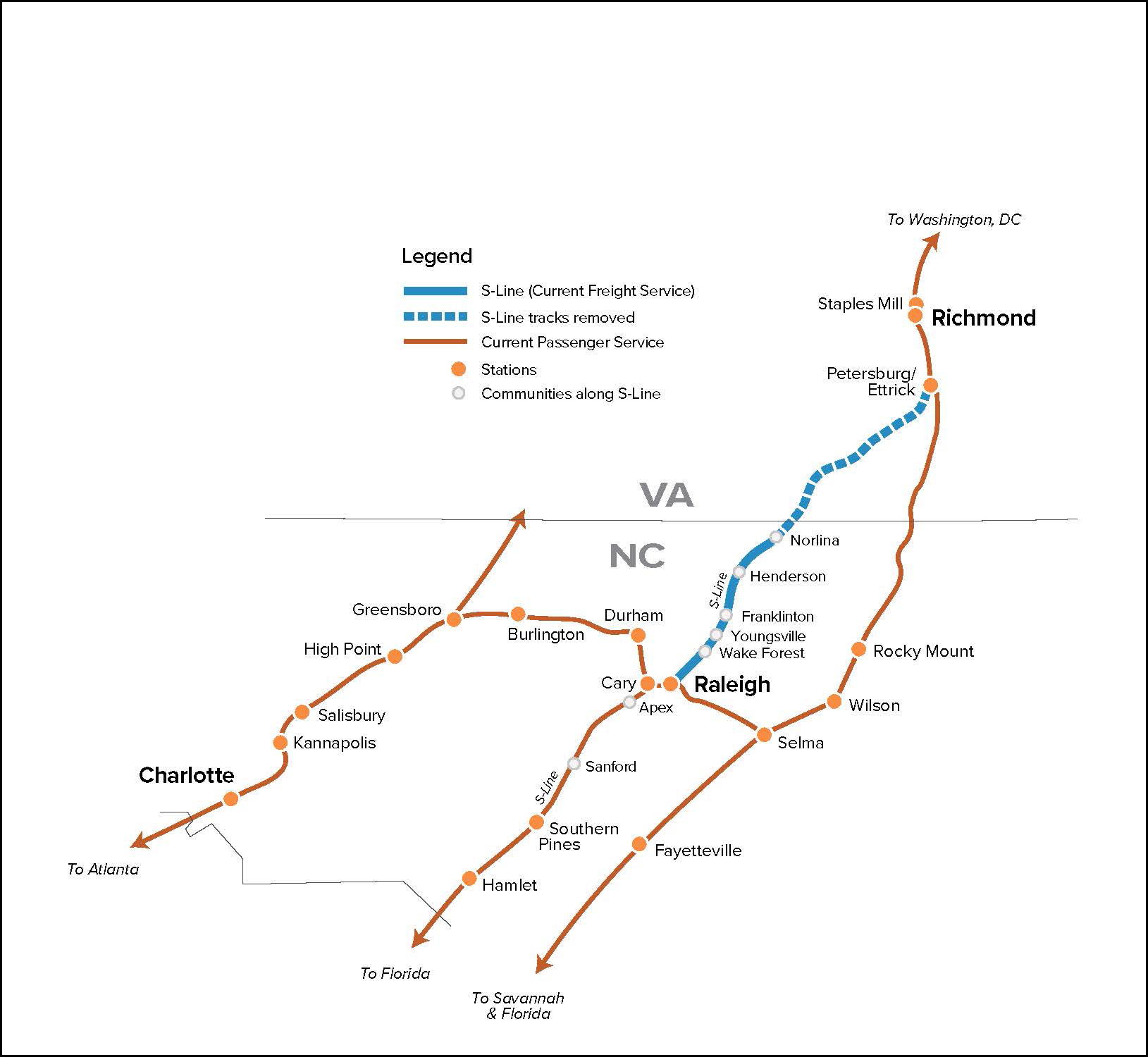
And just last month, North Carolina won a $105 million federal grant to improve rail service between Raleigh and Charlotte. “The N.C. Railroad will use the federal money to make curves less sharp so trains don’t have to slow down as much and to replace tracks to improve speed and reduce maintenance disruptions,” among other improvements, the Charlotte Observer reported.
The infusion of federal grants comes alongside recently completed feasibility studies contemplating new rail service between Raleigh and Wilmington. Initial estimates put the cost of the new route at $810 million.
Plans for the route include a mix of utilizing existing freight lines and the addition of new track to connect those lines, including through Goldsboro. “As the project develops, additional coordination will be needed with host freight railroads to obtain more detailed input, refine the infrastructure needed, and develop agreements to facilitate service,” the study noted.
Another feasibility study examining Raleigh to Asheville train service was completed late last year, but Hurricane Helene’s destruction in western North Carolina is all but certain to have scrambled those plans.
“Along the rivers and streams of WNC, rail lines have been washed out or entirely decimated by floodwaters,” the Asheville Citizen-Times reported. “The damage from Helene has knocked the plan to restore passenger rail to Asheville — an effort nearly 50 years in the making — off course.”
***
Passenger rail, especially in a large and growing state like North Carolina, is alluring. If done properly, expanded rail options could allow for more straightforward and convenient movement between North Carolina’s cities and reduce vehicle traffic. But there’s a reason rail plans have been discussed for decades but rarely executed: It’s very hard and very expensive to do.
North Carolina’s exceptional growth, however, combined with renewed federal funding interest offer hope that passenger rail may be on an upward trajectory to fill some very real transit needs in our state.
Recent Articles
How Wake Forest University Is Serving Those Who Served
Thank you for joining us this Saturday morning. It’s fair to assume that anybody who wore the uniform of one of America’s military branches would qualify as a “veteran” under the law. But that’s not what the law says: A less-than-honorable discharge can strip a former service member of all veteran benefits, including health care,…
The Political Center Is Getting Squeezed
Good Saturday morning and thank you for joining us. With a number of primaries completed (46 by our count) we’re taking a look at some of the political trends emerging from this year’s primary season, and what they may tell us about where both parties are headed. American politics has always had its factions. We think…
Amid a Turbulent Media Environment, TRC Nexus Stands Alone
From the Desk of Mike Rusher Thank you for joining us this Saturday morning. A week ago, the Nexus team sat down to review our performance for the year and get a better sense of which topics and stories are resonating most with C-suites across the state. The timing was good: our latest TRC Nexus…