
Guide to North Carolina’s new legislative maps
Welcome to a perfect fall weekend – thanks for spending a few minutes with TRC Nexus this morning.
Mike Rusher, President of the Results Company, writing today to provide an analysis of the new Congressional, State House and State Senate maps produced by the North Carolina General Assembly to be used in the 2024 election.
I will avoid narration on how we got here and why. But, whether we’re using the third, fourth, or fifth set of new maps in the last decade doesn’t really matter now (and we’ve written some great material on that) – let’s look at what we know:
Seventeen days ago, on October 25, the legislature enacted new maps for the 2024 elections, and we immediately dove into analysis to see where the partisan advantages exist to prepare for what might happen on election night. To calculate a particular district’s partisan advantage, we look to how that district voted in certain statewide races from 2016, 2020, and 2022.
Let’s hop in. Note: You can right click on the images to populate in a new window for larger views.
North Carolina’s U.S. House Map
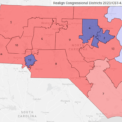
The new Congressional maps essentially draw three Democratic members out of office, and lay a pathway to 10 Republicans, three Democrats members, and one tossup seat. In the above chart, if a district has a 10+ point advantage it’s, “Safe,” if it has a 4-9 point advantage, it’s marked “Lean,” and if it’s within 4 points either direction it’s a tossup. Of note:
- CD-1: Incumbent Rep. Don Davis (D) remains popular and liked in the Northeast part of the state, and though his district is marked as a tossup, on paper, a Democratic candidate holds a 3.14% advantage – Joe Biden won the district in 2020 by nearly 2 percentage points.
- So far, Republicans Laurie Buckhout and Sandy Smith are running on the GOP ticket.
- CD-6: It’s OPEN – Rep. Kathy Manning (D) lives in this district, which favors Republicans by more than 15%. It’s unlikely she’ll run a kamikaze mission here, and former Rep. Mark Walker has already announced his candidacy after a failed 2022 Senate bid and underwhelming 2024 gubernatorial campaign. Expect more GOP candidates to join.
- So far, Republicans Christian Castelli, Jay Wagner, Bo Hines and Mark Walker are seeking the GOP nomination.
- CD-8: It’s OPEN – Incumbent Rep. Dan Bishop (R) is running for State Attorney General, leaving this seat open in a district that broke for Trump by nearly 18% in 2020.
- So far, Mark Harris is the only announced candidate for the GOP. But North Carolina Representative Jarrod Lowery (R- Robeson) announced he was taking a serious look at entering the race.
- CD-13: It’s OPEN – Remember 2022’s lone tossup race, Wiley Nickel (D) against Bo Hines (R)? Many don’t want to. Some expect Nickel to run here, though it’s unlikely a Democratic candidate can win. The district favors Republican’s by more than 15%, and voted for Trump over Biden by 17.2%.
- The Republican field so far has state Rep. Erin Pare, DeVan Barbour, Josh McConkey, Brad Knott, Matt Shoemaker, Eric Stevenson, Fred Von Canon, and Kenny Xu. Many more are expected.
- CD-14: It’s OPEN – This new district carved out some territory from Reps. McHenry and Edwards to make a district that favors Republicans by 15%. Like CDs6, 8, and 13, this race is likely decided by the primary election winner.
- Keep an eye on this one. Special Forces Veteran Pat Harrigan has set his sights on beating outgoing NC House Speaker Tim Moore.
- Expect incumbents to have substantial advantages in: CD-2 (Deborah Ross (D-Wake), CD-3 (Greg Murphy (R-Pitt), CD-4 (Valerie Foushee (D-Durham), CD-5 (Virginia Foxx (R-Watauga), CD-9 (Richard Hudson (R-Moore), CD-10 Patrick McHenry (R-Lincoln), and CD-12 Alma Adams (D-Mecklenburg).
North Carolina State House Map


Buckle up, there’s a lot here. The new NC House maps give 65 districts a “Safe Republican” label by my analysis, four districts “Lean Republican,” five districts are Tossups, and 46 districts are “Safe Democratic.” If a district has an 8-point or greater partisan advantage, that’s marked as “Safe,” if it has a 4-7 point advantage, that’s marked “Lean,” and if it’s within four points either direction, it’s a tossup. Of note:
- There’s 120 districts here but expect to only see action in nine – those are the Tossup and Lean districts.
- If Republicans win seven of those nine they retain a supermajority, but that is no easy task. Three of those nine (Chesser in Nash County’s HD 25, Fontenot in Wilson’s HD 24, and Ward in Pasquotank’s HD 5) face an uphill battle in districts that give an advantage to Democratic candidates by 3.4%, 2.8% and 0.6% respectively.
- The supermajority seat (72) currently sits in House District 5, where Republican Bill Ward is the incumbent.
North Carolina State Senate Map

The maps for the upper chamber of the General Assembly now show 24 Safe Republican districts, three Lean Republican, six Tossups, and 17 Safe Democratic. Like the house maps, if a district has an 8-point or greater partisan advantage, that’s marked as “Safe,” if it has a 4-7 point advantage, that’s marked “Lean,” and if it’s within four points either direction, it’s a tossup. Of note:
- Out of 50 Senate districts, all the action will be focused on the six tossups. Republicans would need to win three of those to maintain a supermajority, while three have a generic Republican advantage (Buck Newton (SD-4), Britt (SD 24), Bode (SD 18)), the other three have a Democratic advantage. Of those six tossup districts, Democrats Rachel Hunt (SD-42, Mecklenburg) and Mary Wills Bode (SD-18, Wake/Granville) have the greatest likelihood to flip from Democrat to Republican. Lisa Barnes’s Nash County-based district now gives a Democratic candidate a slight advantage on paper (1.5%).
- The new 13th district in South Wake County encompasses Fuquay Varina, parts of Holly Springs, Apex, Knightdale, and Garner. This is an open seat and favors Democrats by just over a percentage point, and Biden won the district by a point and a half.
Conclusion
In sum, legislative leaders replaced the court ordered congressional maps (which were put in place after some extremely abnormal maneuvering from the previous State Supreme Court majority) with their own version. As expected, The state legislative maps, on paper at least, do not seem to create much movement away from the current makeup of the General Assembly. Republicans have a major advantage in the congressional districts, but paths to legislative supermajorities are far from certain.
This reality underscores the handcuffs the Stephenson criteria puts on legislators when drawing state district maps. Objective criteria, like keeping counties whole whenever possible, minimizing county splits, etc. make it difficult for legislators to maximize partisan advantage in state redistricting.
From here, candidate tracking will be a focal point as many retirements are expected across the state legislative spectrum.
Recent Articles
How Wake Forest University Is Serving Those Who Served
Thank you for joining us this Saturday morning. It’s fair to assume that anybody who wore the uniform of one of America’s military branches would qualify as a “veteran” under the law. But that’s not what the law says: A less-than-honorable discharge can strip a former service member of all veteran benefits, including health care,…
The Political Center Is Getting Squeezed
Good Saturday morning and thank you for joining us. With a number of primaries completed (46 by our count) we’re taking a look at some of the political trends emerging from this year’s primary season, and what they may tell us about where both parties are headed. American politics has always had its factions. We think…
Amid a Turbulent Media Environment, TRC Nexus Stands Alone
From the Desk of Mike Rusher Thank you for joining us this Saturday morning. A week ago, the Nexus team sat down to review our performance for the year and get a better sense of which topics and stories are resonating most with C-suites across the state. The timing was good: our latest TRC Nexus…