
Anchored in History: The Story of the North Carolina Maritime Museum
Thanks for joining us this Saturday morning.
Ask a person on the street to list North Carolina’s best-known museums, and you’ll probably hear about the Museum of Natural Sciences in Raleigh, or the Museum of Life and Science in Durham.
However, you may not know that one of the state’s oldest, most historic museums is a network of three perched along the coast: the North Carolina Maritime Museum.
Today, we’re diving into the history and promise of the Maritime Museum – perhaps you’ll see fit to visit one of its branches next time you head east.

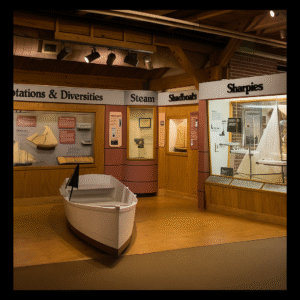
NC Maritime Museum: Beaufort
***
The North Carolina Maritime Museum has three separate locations: the Graveyard of the Atlantic Museum in Hatteras, the North Carolina Maritime Museum at Beaufort, and the North Carolina Maritime Museum at Southport.
But it all started in Bergen, Norway, near the turn of the 19th century.
In 1898, Norway hosted the International Fisheries Exposition. By that time, North Carolina’s fishing industry was maturing. “There are few States having so large a population so entirely dependent on the fisheries for a livelihood,” reported the North Carolina Board of Agriculture in an 1896 analysis. “The fisheries, therefore, possess a great economic interest to the State.”
It’s no surprise, then, that the state sent a delegation to expositions like the one held in Norway. North Carolina’s contribution included “fish casts, bird skins, jars of preserved crustacea, and examples of old fishing tackle,” according to a history of the Maritime Museum published in 2000.
Those exhibits comprised the beginnings of what would become the North Carolina Maritime Museum.
Beginning in 1904, the state showcased the old materials it had trekked around to global expositions at the U.S. Fisheries Laboratory on Piver’s Island, near Beaufort. Years ago, an elderly coastal resident recalled visiting the site as a child in 1917: “My family and I came down from New Bern on an excursion train. We went over to a building on Piver’s Island. It was open to the public on occasion, but it wasn’t an everyday thing. I saw huge turtles there and they were alive and kept in a circular pen. That was quite a sight for a kid five or six years old.”
Over the ensuing decades, the exhibit became known locally as the “fisheries museum.” In 1950, the director of the State Museum of Natural History took the artifacts under his remit, declaring it an “official” museum collection. He moved it to a more prominent location in Morehead City, where it attracted a larger share of visitors and interest.
Later that decade, a state legislator representing Carteret County successfully passed a law formally designating the collection as part of a state museum and appropriated funds to house it in a new facility.
What would become the North Carolina Maritime Museum had gone big time.
The museum changed locations over the following decades, and its collection grew to include boat models and other nautical objects. By 1983, the museum was charged with the high-profile project of reconstructing the Elizabeth II – one of the vessels that brought colonists to North Carolina in the 16th century.
***
Fast forward to today, and the Maritime Museum – all three branches – is operated by the Division of State History Museums within the Department of Natural and Cultural Resources.
“The museums highlight maritime and coastal culture including fishermen, boatbuilders and decoy carvers,” Coastal Review reported, “as well as exhibits [that] tell the tales of painters and pirates, shipwrecks and sailboats and marine life and maritime habitat protection.”

NC Maritime Museum: Beaufort

NC Maritime Museum: Southport
The museum features fun educational programs, especially during the summer, for local kids. And it’s backed by a strong network of boosters, including Preston Development Company, Grady-White Boats, and the Beaufort Hotel, owned and operated by local businessman Bucky Oliver.
The Beaufort location is currently undergoing renovations, including a new HVAC system, and remains closed for the foreseeable future. “This important project will ensure the temperature and humidity within the facility are maintained at consistent levels to keep the collections safe and secure for future generations,” the museum’s website reads.
The museum will surely continue its evolution – from a collection of small artifacts hauled back after a 19th-century Norway exposition, to the network of nautical treasures it is today.
From its humble beginnings as a handful of preserved specimens and fishing gear on display for curious visitors, the North Carolina Maritime Museum has grown into a living chronicle of the state’s deep connection to the sea. Its three branches now serve as gateways to understanding the people, industries, and ecosystems that have shaped coastal life for centuries.
Recent Articles
How Wake Forest University Is Serving Those Who Served
Thank you for joining us this Saturday morning. It’s fair to assume that anybody who wore the uniform of one of America’s military branches would qualify as a “veteran” under the law. But that’s not what the law says: A less-than-honorable discharge can strip a former service member of all veteran benefits, including health care,…
The Political Center Is Getting Squeezed
Good Saturday morning and thank you for joining us. With a number of primaries completed (46 by our count) we’re taking a look at some of the political trends emerging from this year’s primary season, and what they may tell us about where both parties are headed. American politics has always had its factions. We think…
Amid a Turbulent Media Environment, TRC Nexus Stands Alone
From the Desk of Mike Rusher Thank you for joining us this Saturday morning. A week ago, the Nexus team sat down to review our performance for the year and get a better sense of which topics and stories are resonating most with C-suites across the state. The timing was good: our latest TRC Nexus…