Landmark N.C. Civil War History Center Rises in Fayetteville
Thank you for joining us this Saturday morning.
Nearly two centuries ago, bricklayers and stonemasons began construction of what would become the Fayetteville Arsenal. It stored weapons and ammunition, protected by large iron gates, for only a few decades until General William T. Sherman razed it in 1865.
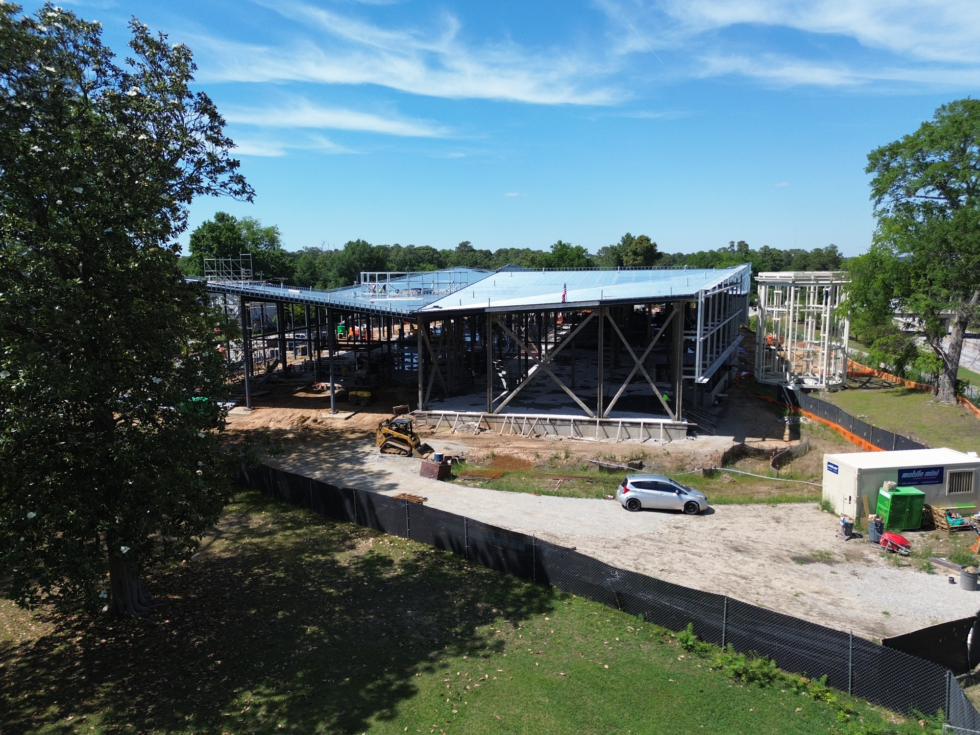
Some remnants remain scattered about the site, visible now to a new group of construction engineers who are building the North Carolina History Center on the Civil War, Emancipation & Reconstruction.
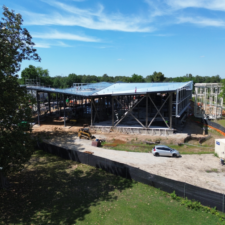
Concrete slab is poured, and metal framing is up. Once complete, the project will be North Carolina’s largest publicly-owned “museum,” though the visionaries who spent the past 20 years bringing the project to life prefer another term: the History Center.
***
One of those visionaries is Mac Healy – owner of Healy Wholesale and chair of the History Center’s board of directors. He told us last month, “We’re not a collection museum. We’ll have some artifacts, but this is about the people of North Carolina and what happened during a critical period in our history.”
Healy continued, “What we’re doing is telling the truth. And we’re focusing most on reconstruction. The vast majority of people, if you asked them, would say everything was kumbaya after the Civil War. That’s not what happened.”
The History Center has engaged scholars throughout the country, including at the National Museum of African American History and Culture, to inform the exhibits that will be on display. The goal, organizers say, is to tell the truth.
Pam Cashwell, who leads the North Carolina Department of Natural and Cultural Resources, said at a groundbreaking ceremony, “This will be the first and only museum in North Carolina focusing on an important part of our history – important, but frankly, overlooked at this point in time – and that’s reconstruction. It’s the story of our state putting itself back together after the Civil War.”
As The Assembly reported in 2025, the History Center’s educational programming will equip educators to better discuss the Reconstruction period with students.
“All of the really, really complex interplays between that history and memory deserve more space than we typically have time to give them,” Michael McEltreath, the History Center’s education initiatives director, said. “That’s the hardest thing about teaching this.”
Indeed, North Carolina has always been a purple, divided state, dating back even to secession. The Civil War ravaged North Carolina, which lost more soldiers at Gettysburg than any other state. Focusing on this formative period – on facts and nuance and how that history shapes us even to this day – offers a rich opportunity for exploration. “As the History Center tells the truth, what people make of it is up to them,” Healy said.
***
But piecing together funding for any project of this scale – much less one centered on the most tumultuous period in North Carolina history – has been a complicated journey.
“If we got the best minds in the state and told the truth with all its blemishes, this would be a world-class center,” Healy told reporters. “That may upset people.”
History Center organizers have faced concerns from all corners. Some local officials expressed unfounded skepticism that the project would glorify the Confederacy. Backers also faced complaints that the campus wouldn’t fly the Confederate flag. Public officials questioned where all the money would come from. And the History Center’s focus became even more sensitive as public controversy swirled over the past decade, first around Confederate monuments and then George Floyd.
But the organizers kept at it, chief among them Mary Lynn Bryan, who is now in her nineties and remains as committed to the project as the day it started, similar to the other founders. “We went to see corporate executives, school boards, superintendents, and more,” Healy said.
In the end, their persistence paid off. The backers pieced together the $85 million they would need to construct the History Center from a combination of private donations, foundations, city dollars, county dollars, and state funding.
It’s a true public-private partnership. The state isn’t well equipped to build new museums on its own, which is why Healy and private partners are leading construction. The NC Department of Natural and Cultural Resources will ultimately operate the center once it’s open, likely in 2028, an arrangement Heally describes as a “hand-off” between the program’s private and public stakeholders.
Exhibition content has been developed independently by national experts in the field. And operational costs will be covered through a private endowment – organizers have already raised $4 million toward their $5 million goal.
“North Carolina is one of the few states willing to go out and tell this story of reconstruction,” Healy said. He expects Fayetteville to benefit from that boldness.
When the History Center opens its doors in 2028, it will stand on the same ground where an arsenal once stored the weapons of a divided nation. Instead of iron gates guarding ammunition, glass doors will now open today’s generation to an honest reckoning with who North Carolinians are and how they got here.
The Reconstruction era has long been misunderstood, even minimized – but Fayetteville is betting that the truth, told plainly and without apology, is compelling enough to draw visitors, challenge assumptions, and yes, maybe upset a few people along the way.
If Healy and his collaborators are right, what rises from the remnants of that old arsenal will be more than just a “museum” – it will be proof that a state can look clearly at its most painful chapters and choose to learn from them.
Recent Articles
Landmark N.C. Civil War History Center Rises in Fayetteville
Thank you for joining us this Saturday morning. Nearly two centuries ago, bricklayers and stonemasons began construction of what would become the Fayetteville Arsenal. It stored weapons and ammunition, protected by large iron gates, for only a few decades until General William T. Sherman razed it in 1865. Some remnants remain scattered about the site,…
November Ballot Questions Decide N.C.’s Future Tax Environment
Thank you for joining us this Saturday morning. This November, North Carolinians will have the opportunity to amend their constitution again. They’ll decide on at least two tax-related proposals: a 3.5% cap on the state’s income tax rate, and a requirement for state lawmakers to limit property taxes imposed by local governments. After 15 years of policy choices that…
Four North Carolina Legends, One Enduring Idea
Thank you for joining us this Saturday morning. In 1989, Financial World magazine surveyed corporate America and crowned its “CEO of the Decade.” The honor did not go to a Wall Street financier or a Silicon Valley pioneer. It went to a soft-spoken Charlotte engineer named Bill Lee, the chairman of Duke Power. Lee had joined…