North Carolina’s Bold First Step: Remembering the Mecklenburg Declaration
From the desk of Mike Rusher
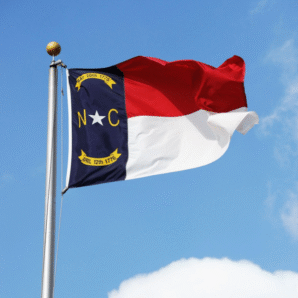
Some time ago I was asked the question, “Do you know what the two dates on our state flag signify?” My mind raced back to American history classes – where does your mind go?
The North Carolina state flag features two dates, highlighted in yellow ribbon: April 12, 1776, the date North Carolina signed the Halifax Resolves, and a date you may not have heard much about: May 20, 1775.
We are just days away from the 250th anniversary of May 20, 1775, which marks one of North Carolina’s most consequential actions during the Revolutionary period. We’ll take a look at this date’s importance and highlight several events taking place to commemorate the occasion. Special thanks to our friends at The American Battlefield Trust for their time, insights, and partnership.
***
The Mecklenburg Declaration of Independence was signed on May 20, 1775, by Mecklenburg County leaders who declared independence from Great Britain. Importantly, the signing took place over a year before the United States’ Declaration of Independence was adopted at the Second Continental Congress in 1776.
The story of how this document came to be is nothing short of fascinating. After hearing of the battles at Lexington and Concord, Mecklenburg delegates convened to produce a declaration that severed ties with the British Crown. They left the meeting with five resolutions that reshaped North Carolina’s relationship with England and the world. Click here to read the full text of the Declaration.
Here’s where things get a bit complicated. The original document was destroyed in a fire in 1800, and what survives are copies based on oral recollections produced several decades later. John McKnitt Alexander, who clerked the meeting where delegates signed the documents, recreated them from memory and shared them with his son, Joseph. Joseph proceeded to publish his father’s reproduction in both the Raleigh Register and North Carolina Gazette in 1819.
As expected, claims emerged that the Declaration was a fraudulent attempt by North Carolina to claim the first call for independence. In response, North Carolina Sen. Nathaniel Macon took on the role of defending the document’s historical authenticity.
Macon interviewed the eyewitnesses to the Declaration’s signing who were still living at the time. He was able to corroborate their claims that a document declaring North Carolina’s independence from the Crown was read in Charlotte, although few of the men remembered the exact date. One man, Captain James Jack, said that after the document was signed, he rode on horseback to Philadelphia to present it to the NC delegation at the 1775 Continental Congress, only to be turned away because the delegates were not yet ready to consider a motion for independence.
The Declaration is of great significance because it is the earliest known document to directly declare independence from Great Britain. It’s much punchier than the Halifax Resolves, which authorized North Carolina’s delegates to vote for independence at the upcoming Continental Congress. In particular, “[we]…absolve ourselves from all allegiance to the British Crown, and abjure all political connection, contract, or association, with that nation, who have wantonly trampled on our rights and liberties — and inhumanly shed the innocent blood of American patriots at Lexington.” This passage is a splendidly rude and radical trifecta which 1) bluntly rejects the Crown, 2) calls out their inhuman bloodshed, and 3) morally condemns British authority.
Sometimes the Declaration is confused with the similarly named Mecklenburg Resolves, a set of measures adopted in May of 1775 to declare the Tar Heel state’s rejection of Britain’s oppressive laws.
The Mecklenburg Declaration date appeared on the first official state flag adopted in 1861, during North Carolina’s secession from the Union.
***
This year marks the 250th anniversary of both the Mecklenburg Declaration and Resolves, but next year North Carolina will join the entire country in celebrating the 250th anniversary of our formal Declaration of Independence. It’s a momentous occasion, one that TRC Nexus and I have written about consistently, and will usher in grand celebrations across the country.
National
The White House created a task force (Task Force 250) to undertake the planning of a full year of events beginning this Memorial Day and leading up to July 4, 2026. Task Force 250’s goal is to engage with federal, state, and local governments, as well as private, nonprofit, and educational entities, to stir up excitement and participation in the 250th birthday festivities. The group debuted an original video series, produced in conjunction with Hillsdale College, titled “The Story of America,” to provide a visual history of the American Revolution.
There’s also the U.S. Semiquincentennial Commission, established by Congress in 2016 to assist with the planning and orchestration of the anniversary celebrations. It’s composed of a mix of senators, representatives, former officials, and current members of President Trump’s cabinet, like Defense Secretary Pete Hegseth and Secretary of State Marco Rubio.
Dubbed the America 250 Commission, the group is coordinating nationwide commemorations by leading educational programs and organizing community events that celebrate the American Revolution across the country. Most notably, the group is inviting students to participate in a program called America’s Field Trip. Students in grades 3-12 are eligible to submit a written or visual response to the prompt, “What does America mean to you?” to enter for the chance to win extraordinary, exclusive visits to some of the country’s greatest landmarks.
Stateside
In North Carolina, a host of events are being organized to celebrate America’s 250th anniversary, and some are happening next week. The American Battlefield Trust (ABT) is hosting a premiere of a North Carolina edition of “Travels with Darley: Revolutionary Road Trip,” at the Nature Research Center in downtown Raleigh on May 21. Hosted and produced by award-winning PBS TV personality Darley Newman, the feature takes viewers through North Carolina’s rich revolutionary history by visiting some of the state’s most iconic colonial landmarks.
See below for info about how to attend the documentary premiere and to learn more about a legislative breakfast, happening on the same day as the premiere, to get a chance to meet Darley Newman, network with other North Carolina colonial history enthusiasts, and connect with legislators in attendance.
Legislative Breakfast (grab and go networking event)
- When: Wednesday, May 21 | 7:30–9:30 AM
- Where: Explore on Four Meeting Room – 4th Floor Nature Exploration Center, 11 W. Jones Street, Raleigh, NC 27601
Exclusive Screening of “Travels with Darley: Revolutionary Road Trip”
- When: Wednesday, May 21 | 6:00 – 8:00 PM
- Where: Nature Research Center – 4th Floor Environmental Conference Center & Rooftop Terrace, 121 West Jones St, Raleigh, NC 27603
Please consider this a personal invitation to both of these events. To attend, please RSVP to Luke McKnight at lmcknight@battlefields.org, and feel free to share these events, by forwarding this email, to your friends.
Onward! 

Recent Articles
How Wake Forest University Is Serving Those Who Served
Thank you for joining us this Saturday morning. It’s fair to assume that anybody who wore the uniform of one of America’s military branches would qualify as a “veteran” under the law. But that’s not what the law says: A less-than-honorable discharge can strip a former service member of all veteran benefits, including health care,…
The Political Center Is Getting Squeezed
Good Saturday morning and thank you for joining us. With a number of primaries completed (46 by our count) we’re taking a look at some of the political trends emerging from this year’s primary season, and what they may tell us about where both parties are headed. American politics has always had its factions. We think…
Amid a Turbulent Media Environment, TRC Nexus Stands Alone
From the Desk of Mike Rusher Thank you for joining us this Saturday morning. A week ago, the Nexus team sat down to review our performance for the year and get a better sense of which topics and stories are resonating most with C-suites across the state. The timing was good: our latest TRC Nexus…