Building Foundations: The Enduring Legacy of Raleigh’s Martin Marietta Center
Good morning and thank you for joining us.
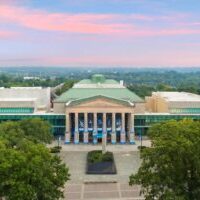
One of Downtown Raleigh’s oldest and most iconic anchors is the Martin Marietta Center for the Performing Arts. Today, the venue hosts events from orchestral performances to standup comedians to holiday ballets. Every year, the entertainment facility generates around $35 million in economic activity and attracts over 400,000 visitors.
The Center is also one of the capital city’s most historic venues. Today, we’ll tell the story of an institution that survived wars, fires, renovations, and more to become Raleigh’s premier arts destination. We’ll also explore Martin Marietta’s championing of the arts and how CEO Ward Nye looks to connect his company with the City of Oaks.
***

The Center has operated as a public venue since 1932, when the building was inaugurated as the Raleigh Memorial Auditorium. But its history goes back much further and includes run-ins with many historic state and national figures.
In 1792, when the General Assembly moved the state capital from New Bern to Raleigh, the governor’s office relocated as well. Calls for a formal and elaborate mansion befitting a head of state led to the construction of the Governor’s Palace in 1813 on the site that now features The Center. Governor William Miller became the first to call the residence home in 1816.
Just a few years later, Governor Hutchins Burton reportedly hosted Marquis de LaFayette on his grand reunion tour to the United States.
After the statehouse burned down in 1831, the General Assembly held sessions in the Palace while legislators waited for the construction of the new statehouse to finish.
Governor Zebulon Vance – the last state leader to live in the Palace – fled the grounds in 1865 as Union troops reached the outskirts of Raleigh in the waning days of the Civil War.
General William T. Sherman advanced on the capital and swiftly took Raleigh. He used the Palace as his headquarters and meeting place to rendezvous with figures like General Ulysses S. Grant. The army utilized the building as a regional headquarters for over a decade before it was eventually sold back to the City of Raleigh.
As the country settled into life after the Civil War, many buildings shed their war-time duties and returned to their civilian uses. The old Governor’s Palace burned down in 1930, and soon thereafter was rebuilt as the Raleigh Memorial Auditorium, or “the Memorial.”
The venue hosted several historic events in the decades that followed:
- Duke and NC State played a Southern Conference Championship game on Memorial’s stage in 1942.
- During a meeting for the Southern Christian Leadership Conference, Dr. Martin Luther King Jr. addressed a crowd of 1,600 in the Auditorium.
- In 1986, George H. W. Bush spoke while he was Vice President to Ronald Reagan.
The Memorial Auditorium became one of the state’s premier venues and a vitally important piece of the Downtown Raleigh landscape. But like any good performer, Memorial was just warming up for its main act.
***

Over the past several decades, The Center has modernized and expanded, reaching out to different segments of the performing arts community.
- In 1975, the Auditorium converted its seating from a flat concrete floor to raked theater-style seating common in many performing arts centers.
- In 1990, a new outer lobby space was added, enhancing the facility’s curb appeal, along with new sparkling chandeliers that immediately draw attention from any visitor. Upgrades to seating reduced the venue’s capacity from 4,000 to 2,300, giving the room a more intimate, exclusive feel common to many of the country’s best theaters.
Using a mix of private and public funding, The Center added the Meymandi Concert Hall and the A.J. Fletcher Opera Theater in a $35 million expansion that opened in 2001.
Meymandi Concert Hall, a 1,700-seat shoebox design, is a state-of-the-art symphony hall that enables Raleigh to host some of the country’s greatest symphonic performers. Meymandi is the official home of the North Carolina Symphony. The Symphony’s 300 performances a year reach all 100 NC counties and serve as important events in the cultural and artistic life of our state.
Fletcher Theater is a 600-seat setting with a more typical theater build. It’s here that The Center hosts many comedians and off-Broadway productions. The Center recently began hosting VIP dinners on Fletcher’s stage, giving visitors an opportunity to experience The Center in a unique way.
Also a part of the 2001 renovation is the 150-seat Kennedy Theater, a “black box” theater that hosts a variety of unique performances in an intimate, up-close setting.
And they’re not done expanding yet. Officials at the venue say they’re getting ready to open a new outdoor plaza space later this year, and upgrade the facility’s’ outdoor environment and ADA accessibility. They also plan to improve the performer dressing rooms, many of which haven’t been updated in over 40 years.
***

Progress Energy (now Duke Energy) bought the naming rights to The Center in 2005. They maintained the rights until Martin Marietta struck a deal in 2023.
Martin Marietta CEO Ward Nye, a Triangle native, says the company’s Raleigh roots underpinned the decision to lend its name to The Center. “Our people live in this community and raise their families here. They attend our schools and churches,” Nye said. “When they either drive by the Martin Marietta Center for the Performing Arts or attend a performance, I know it makes them proud… knowing that the company where they’re building their careers is the same company that strives to have a positive impact on their community.”
Visitors entering The Center from South Street encounter a massive Martin Marietta boulder with The Center’s logo emblazoned on the front. Taken from the company’s quarry in Garner, the rock is a visible reminder of the building materials supplier’s primary mode of business. In many ways, the large stone is symbolic of how The Center has stood as a pillar of the Raleigh community for more than a century, a feat Martin Marietta wishes to emulate.
Nye sees The Center as a key way for his company to engage with The Triangle. Martin Marietta’s global headquarters, located in Raleigh’s GlenLake Office Park, make it one of the region’s more recognizable businesses.
Nye says they try to leverage that position, being a “good neighbor when and where we are needed.” Martin Marietta has financially supported projects like the UNC Heart & Vascular Hospital and the UNC Rex Cancer Center, and provides financial assistance to organizations like the Dix Park Conservancy. They also are the title sponsor for one of Raleigh’s biggest annual events – the City of Oaks Marathon.
Nye says the community engagement is all a part of Martin Marietta’s mission: “Each of these efforts has a different impact on our community, yet all of them make The Triangle a better place to live. This is directly in line with everything we do at Martin Marietta.”
Martin Marietta’s deal with The Center for the Performing Arts is set to last as many as 30 years, and Nye says it’s all worth it.
He said, “Any time you put your company name on a public building – let alone a 100-year-old structure that has long stood as a pillar of the community – you’re going to strengthen your brand recognition… But it’s deeper than that for us. We want to ensure our partnership with The Center is one that will always reflect our shared commitment to the people of Raleigh and the greater area.”
It’s that commitment to the betterment of the community that drives Martin Marietta’s involvement with The Center. On its company website, the building materials giant says it supplies “the resources necessary for building the solid foundations on which our communities thrive.” With The Center for the Performing Arts, Martin Marietta is laying a solid foundation for North Carolina’s greatest actors and musicians for years to come.
Recent Articles
How Wake Forest University Is Serving Those Who Served
Thank you for joining us this Saturday morning. It’s fair to assume that anybody who wore the uniform of one of America’s military branches would qualify as a “veteran” under the law. But that’s not what the law says: A less-than-honorable discharge can strip a former service member of all veteran benefits, including health care,…
The Political Center Is Getting Squeezed
Good Saturday morning and thank you for joining us. With a number of primaries completed (46 by our count) we’re taking a look at some of the political trends emerging from this year’s primary season, and what they may tell us about where both parties are headed. American politics has always had its factions. We think…
Amid a Turbulent Media Environment, TRC Nexus Stands Alone
From the Desk of Mike Rusher Thank you for joining us this Saturday morning. A week ago, the Nexus team sat down to review our performance for the year and get a better sense of which topics and stories are resonating most with C-suites across the state. The timing was good: our latest TRC Nexus…