Genius or Contemptible? A Historical Perspective on the United States’ Use of Tariffs
Thank you for joining us this Saturday morning. Tariffs have dominated the news cycle for the past several weeks, and understandably so. The see-saw has roiled markets and called into question the very future of international trade.
The contours of the debate go something like this: Proponents say the United States has been on the losing end of trade deals since the 1970s. Tariffs can finally right that wrong by forcing trading partners to renegotiate terms. A strain of thinking in the proponent sphere also sees tariffs as an opportunity to reignite American industrial production.
Opponents say ironclad economic principles have long held that tariffs depress economies by shrinking the “pie” for all sides while also sparking inflation as the price of goods necessarily increases. Manufacturing jobs will not return to the United States regardless of tariff policy because the American economy has simply moved past its manufacturing era, just like other advanced economies.
Who is right? Our purpose today isn’t to answer that question for you. It’s to provide you with historical context and a deeper understanding of the American experience with tariffs so you can be better informed.
***
The Pre-Hegemonic Era: 1789-1945
“The duties [on foreign articles] are sometimes laid with a view merely to the increase of revenue… but it is not less true, that they have been frequently imposed with a view to the encouragement of manufactures.”
So argued Treasury Secretary Alexander Hamilton in his 1791 Report on Manufactures. Hamilton’s landmark treatise foreshadowed – or, perhaps, set in motion – a federal industrial policy that has persisted for more than 200 years. Hamilton argued for strong federal involvement in promoting domestic manufacturing through tariffs, subsidies, and infrastructure improvements, though many of his contemporaries disagreed with that path forward.
Many of the arguments bandied about today – as in right now on CNBC – can be found in Hamilton’s 1791 report and the reaction to it.
In the decades that followed, Congress imposed tariffs of all sorts. The first overtly protectionist tariff came in the aftermath of the War of 1812, when Congress enacted average duties of 20-25 percent on goods deemed important to national security and warding off reliance on Great Britain.
The fist major tariff debate, though, happened in 1828, when a bitterly divided Congress enacted the “Tariff of Abominations.” The measure imposed double-digit tariffs on some imported finished goods and raw materials to “protect northern and western agricultural products from competition with foreign imports.” It instigated what came to be known as the Nullification Crisis, wherein South Carolina argued that it did not need to follow federal laws that it deemed unconstitutional.

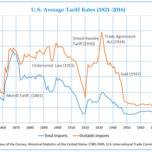
Tariff rates ebbed and flowed over the next 100 years depending on the political and economic climate. Throughout the 19th century, tariffs provided the vast majority of federal revenue – as much as 95% at times.
After the federal income tax began in earnest after 1913, the proportion of federal revenue captured from tariffs declined sharply.

Source: Peterson Institute for International Economics
During the 19th and early 20th century, the United States grew from a scrappy and idealistic newcomer into the world’s preeminent economic power. Like an awkward teenager after a growth spurt, she wasn’t quite willing or able to assert her new-found power. As Henry Kissinger recounts in his 1994 work Diplomacy:
“By 1885, the United States had surpassed Great Britain, then considered the world’s major industrial power, in manufacturing output. By the turn of the century, it was consuming more energy than Germany, France, Austria-Hungary, Russia, Japan, and Italy combined. Between the Civil War and the turn of the century, American coal production rose by 800 percent, steel rails by 523 percent, railway track mileage by 567 percent, and wheat production by 256 percent. . .
But the American Senate remained focused on domestic priorities and thwarted all expansionist projects. It kept the army small (25,000 men) and the navy weak. Until 1890, the American army ranked fourteenth in the world, after Bulgaria’s, and the American navy was smaller than Italy’s even though America’s industrial strength was thirteen times that of Italy.”
Whether protectionist tariffs enabled that growth or it happened despite them is a matter for economists to debate. But this reality is indisputable: By the time of the First World War, the United States was the consummate power of the global economy. The US got there after more than a century of inward focus, eschewing involvement in the affairs European, Asian, and African nations.
But, as Kissinger wrote, a country “will not forever resist the temptation of translating [power] into a position of importance in the international arena.”
***
The Hegemonic Era: 1945-Present
The United States emerged from the Second World War with relative military and economic strength unmatched in the history of the world. Her dominance over of all peers was absolute.
From that position of strength, the United States enforced a new world order that involved declining tariffs, freer trade, and an almost messianic commitment to liberty and democracy.
Whether that was good for America, or whether such a posture should have persisted for so long, is central to the current tariff debate.
Here’s how Victor Davis Hanson, a classics and military historian at Stanford University’s Hoover Institution who is sympathetic to President Donald Trump’s tariff policy, describes the hegemonic era in The Free Press:
“A recovering Europe and Asia needed massive inputs of goods and services. The Truman administration complied out of both genuine global ecumenicalism and its own self-interest in profiting from supplying what the world then lacked—from steel, cars, machinery, and appliances to food, fuel, chemicals, and financial resources. Furthermore, to accelerate growth in both continents, the U.S. dropped its fondness for protective tariffs and inaugurated “free trade”—even if defined as asymmetrical and nonreciprocal.
The fear of economic collapse and the spread of communism made transitory worries about deficits mostly academic until 1950. Yet even when deficits began to become chronic, presidents still justified or ignored them ostensibly for both strategic and humanitarian reasons.
The Cold War, then, gave further justification to the idea of free—but not necessarily fair—trade. From the 1950s onward, Washington was indifferent to trade balances, as allies like West Germany, Japan, and South Korea were prodded to become strong economic and military bulwarks against Soviet and Chinese communist agendas.
By 1975, however, annual trade deficits grew larger and were uninterrupted. Yet in response, American postwar free-trade policies remained mostly unchanged despite a radically changed world. Presidents mostly either ignored, discounted, or did not grasp the dire implications of the growing transference of American manufacturing overseas, and the rising importation of big-ticket items like cars and appliances as well as a flood of cheap consumer goods.”
“In reductionist terms,” Hanson concludes, “those tasked with directing U.S. trade policy rarely cared to calibrate the real social, cultural, and moral costs of millions losing high-paying jobs.”
A different theory of post-World War II trade policy – and one that enjoys more consensus – comes from Anne Krueger, a former World Bank chief economist and a professor at Johns Hopkins University:
“The governance of international trade shifted dramatically after World War II, when the United States emerged as a dominant economic and military power. Instead of seeking economic concessions from defeated countries, American leaders championed the creation of an open, rules-based trading system.
The multilateral trading system – institutionalized through the General Agreement on Tariffs and Trade and its successor, the World Trade Organization – benefited the US and the rest of the world, ushering in eight decades of unprecedented economic growth. By the 1990s, even protectionist developing-country governments recognized free trade as an effective way to reduce poverty and raise living standards.
Over the years, trade barriers were gradually lowered as the WTO promoted open global trade, resolved disputes, and facilitated negotiations for reciprocal tariff reductions and the elimination of other trade restrictions. Until about a decade ago, this system was widely regarded as a success.”
***
Although Trump has occasionally suggested that his goal is to pressure other countries to lower tariffs or reduce their trade surpluses, such claims are no longer taken seriously by many. The European Union, for example, offered to eliminate all industrial tariffs if the US would do the same – but Trump declined. He has also imposed tariffs on Mexican and Canadian imports despite the free-trade agreement he himself negotiated during his first term. Singapore, which maintains zero tariffs on American goods and runs a trade deficit with the US, was nonetheless hit with the baseline 10% tariff.
For better or for worse, these actions violate both the spirit and the letter of WTO rules, and represent a clear departure from longstanding American commitments.
The battle lines essentially come down to these questions: Did the American post-World War II order benefit the United States, including its working class? Or has the United States been a sucker since the 1970s and we’re just now figuring it out?
Recent Articles
How Wake Forest University Is Serving Those Who Served
Thank you for joining us this Saturday morning. It’s fair to assume that anybody who wore the uniform of one of America’s military branches would qualify as a “veteran” under the law. But that’s not what the law says: A less-than-honorable discharge can strip a former service member of all veteran benefits, including health care,…
The Political Center Is Getting Squeezed
Good Saturday morning and thank you for joining us. With a number of primaries completed (46 by our count) we’re taking a look at some of the political trends emerging from this year’s primary season, and what they may tell us about where both parties are headed. American politics has always had its factions. We think…
Amid a Turbulent Media Environment, TRC Nexus Stands Alone
From the Desk of Mike Rusher Thank you for joining us this Saturday morning. A week ago, the Nexus team sat down to review our performance for the year and get a better sense of which topics and stories are resonating most with C-suites across the state. The timing was good: our latest TRC Nexus…