
The Bottom Line in the NC Supreme Court Race
Thank you for joining us this morning. The election for a seat on the North Carolina Supreme Court still has not been formally called, and the legal controversy swirling around it has attracted international headlines.
We occasionally use our Saturday space to deliver to you a need-to-know primer on a complex current event commanding a lot of attention in North Carolina political and business circles. This contested election fits the bill.
Today we dive into what’s happening, why it’s happening, and how all of it might end. Thanks for reading.
***
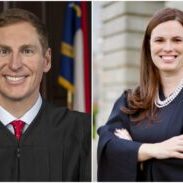
Going into November 2024, Republicans held a 5-2 advantage on the state Supreme Court. One seat was up for grabs, held by Associate Justice Allison Riggs.
Court of Appeals Judge Jefferson Griffin challenged Riggs. A victory for Griffin would’ve secured a Republican majority on the Supreme Court through at least 2028, barring any unexpected vacancies.
After most of the ballots were tallied on election night, Griffin led Riggs by thousands of votes. But that lead slowly evaporated in the following days as provisional and absentee ballots were added to the mix.
By the end of it all, including two recounts, Griffin trailed Riggs by just 734 votes – a razor-thin margin reminiscent of Chief Justice Paul Newby’s 401-vote win over Cheri Beasley in 2020.
It would have ended there, but in mid-December Griffin filed lawsuits against the State Board of Elections that center on three arguments, which we’ll explain shortly. On Jan. 7, the state Supreme Court delayed certification of the results. On Jan. 22, the high court returned the matter to Wake County Superior Court and ordered the case heard “expeditiously.”
The Board of Elections also asked federal courts to intervene. So far the federal courts have declined to do so. This week the Fourth Circuit Court of Appeals largely concurred with the District Court ruling, declaring that the state courts were the proper venue for this legal dispute.
So, what is Griffin’s argument for changing the apparent outcome of the election?
He contests three different sets of voters. For all three, Griffin doesn’t allege that the voters themselves intentionally violated state law. Rather, Griffin alleges the Board of Elections violated state law in crafting the rules under which these voters submitted their ballots.
The first group is people who live overseas and cast absentee ballots without including a copy of a photo ID. There are 5,509 such voters. Griffin argues that the State Board of Elections improperly exempted this group from a state law that requires all in-person and absentee voters to submit photo identification with their ballot. He has a strong argument, as the State Board’s purported rationale for this exemption does not seem to align with state law.
The second group Griffin contests are people born in other countries who never lived in North Carolina, but vote as North Carolinians nonetheless. There are 267 such voters, not enough to change the outcome of the election. National Review offers the most succinct summary of this group: “The State Board counted the votes of overseas voters who have never resided in the United States, but whose parents were last eligible to vote in North Carolina. As Griffin notes, the North Carolina constitution has, continuously since 1776, required voters to reside where they vote.”
The last group has garnered the most attention even though, or perhaps because, it seems the weakest argument. There are 60,273 voters who registered since 2004 without providing legally required information like driver’s license or Social Security numbers. But some of these voters have been casting ballots in North Carolina for decades, and they likely don’t even know their registration is missing information.
In a dissent to the Supreme Court’s order delaying certification of the election results, Republican Justice Richard Dietz wrote: “In my view, this portion of the argument is almost certainly meritless. I also do not view it, having read Judge Griffin’s petition, as a central part of the argument.”
The complex case has two branches. As a strict matter of the letter of the law, Griffin makes a straight-face argument – at least on the first two groups of voters – that may well be compelling to the judges who will decide it. For example, it’s entirely reasonable to look at state law, which requires voters to submit photo identification with absentee ballots, and conclude the State Board erred in not requiring overseas voters to submit photo identification.
But the second branch is the practical reality of overturning the results of an election after the fact because election officials did not properly interpret state law when crafting the rules of the road. This is a version of the federal Purcell doctrine, which holds that federal courts should not involve themselves in election law disputes close to an actual election.
Dietz, in his dissent, writes forcefully about the potential consequences: “Although these challenges to our state’s election laws and regulations might be meritorious, they are not ones that can change the rules of an election after the voters of our state already went to the polls and voted. Permitting post-election litigation that seeks to rewrite our state’s election rules—and, as a result, remove the right to vote in an election from people who already lawfully voted under the existing rules—invites incredible mischief. It will lead to doubts about the finality of vote counts following an election, encourage novel legal challenges that greatly delay certification of the results, and fuel an already troubling decline in public faith in our elections.”
The time to bring these challenges, Dietz wrote, was well before voting began.
Late Friday, Wake County Superior Court Judge William Pittman rejected all three of Griffin’s protests. The case found itself in before Judge Pittman after Griffin filed his initial complaint directly with the state Supreme Court, which ordered it back down to lower court with a stay to block election certification until the petitions run their course through the legal process. Judge Pittman is was first appointed by former Democratic Gov. Mike Easley, and the ruling will almost assuredly be appealed to the state Appellate Court – after which, it may be headed back to state Supreme Court and perhaps SCOTUS.
The legal process will likely take weeks or months to fully resolve. Additionally, Riggs indicates that if there is adverse ruling on the State level, she may appeal it to the federal system, even further saying the results.
The only unfortunate bottom line here is that North Carolinians will have to wait to find out who will serve in this North Carolina Supreme Court seat – and hopefully now you have a better understanding of what’s happening behind the scenes.
Recent Articles
How Wake Forest University Is Serving Those Who Served
Thank you for joining us this Saturday morning. It’s fair to assume that anybody who wore the uniform of one of America’s military branches would qualify as a “veteran” under the law. But that’s not what the law says: A less-than-honorable discharge can strip a former service member of all veteran benefits, including health care,…
The Political Center Is Getting Squeezed
Good Saturday morning and thank you for joining us. With a number of primaries completed (46 by our count) we’re taking a look at some of the political trends emerging from this year’s primary season, and what they may tell us about where both parties are headed. American politics has always had its factions. We think…
Amid a Turbulent Media Environment, TRC Nexus Stands Alone
From the Desk of Mike Rusher Thank you for joining us this Saturday morning. A week ago, the Nexus team sat down to review our performance for the year and get a better sense of which topics and stories are resonating most with C-suites across the state. The timing was good: our latest TRC Nexus…