
Understanding Housing Affordability Versus Affordable Housing
April 1st, 2023
Happy Saturday morning. Thanks for joining us. Today we’re taking a look at a pressing topic for the fast growing Tar Heel State…
Housing affordability and affordable housing – do they mean the same thing?
Yes and no and, as Dr. Seuss would say, “maybe, not quite.”
They’re often used interchangeably, but each represents one of two lines on the supply and demand chart from Economics 101. And each, therefore, represents one of two fault lines in the policy debate over how to enable more people to afford their residences.
As you’ll see, there’s a great absurdity to this. Federal and state policy subsidizes buyers who can’t afford housing. But buyers can’t afford housing because local policy restricts supply.
***
Three weeks ago, Time Magazine reported Greensboro, NC has the seventh-lowest housing supply in the country.
It follows a November 2022 report that rent for a one-bedroom apartment in Greensboro increased by 74% over the prior year – the highest rise in the country.
In Guilford County, nearly one-third of renters spend more than 30% of their income on rent. In Cumberland County, the figure is closer to 40% of renters.
According to a study published by Cato Institute, a Washington, DC-based thinktank, North Carolina home prices have increased 31.5% since 2010.
There’s clearly a problem. And according to the Cato study, it’s a problem other states have experienced before: “In many ways, North Carolina is beginning to resemble California at the end of the last decade or Florida in recent years. In both states, prosperity drove an increasing demand for housing that their markets failed to meet…”
How, then, to resolve it?
***
“Affordable housing” advocates propose subsidies for people in need of housing to help defray costs. The residences in which subsidy recipients live are often called “affordable housing” units.
The North Carolina Housing Finance Agency (NCHFA), for example, offers an array of demand-side programs backed by state and federal funds. Those include down payment assistance, mortgage rate reductions, and incentives for developers to set aside a portion of their units as below-market-rate “affordable housing” for low-income families. The programs are means-tested.
But these policies can’t fix the underlying problem because targeted subsidies for a tiny fraction of people will not change the overall demand quantity for housing.
Changing the overall demand quantity for housing would require eliminating a large proportion of market-rate home-seekers through massive subsidies. Zillow puts the total value of the American residential real estate market at $43.4 trillion.
***
Perhaps the only way to really impact housing affordability is on the supply side.
In theory, it’s rather simple. If there are too few housing units to meet demand, prices will rise. In high-price conditions, developers will build more housing units (because they’ll make more money from them) until prices drop.
When there are too many housing units, prices will fall. In low-price conditions, developers will build fewer housing units because they’ll make less money from them (or no money at all).
Well, home prices are rising, so why aren’t developers building more housing units? The Cato study offers an answer: “Many communities in the state have exacerbated the problem by making it difficult to build enough housing to meet growing demand.”
There’s a great absurdity to this. Federal and state policy subsidizes buyers who can’t afford housing. But buyers can’t afford housing because local zoning policy restricts supply. And the more demand-side subsidies state government offers, the easier it is for local governments to keep restricting supply.
Restrictive zoning policies take many forms, but the worst offenders forbid any housing type other than single-family homes on large lots. That zoning type yields the lowest possible density for a given acreage.
In Raleigh, 88% of residential land is restricted to detached single-family homes. In Charlotte and Greensboro, it’s 84%.
And zoning codes have become mind-bogglingly complex. In 1958, Charlotte’s zoning code was all of 20 pages. Today it’s 889 pages.
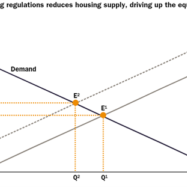
As the basic economics graph below shows, the end result of restrictive and ornate local zoning policy is an unnaturally low supply of housing. And the end result of an unnaturally low supply of housing is an unnaturally high price for housing:

***
State lawmakers recognize there’s a problem, and they also recognize that the solution lies on the supply side.
Senate Majority Leader Paul Newton (R-Cabarrus), together with Sens. Tim Moffitt (R-Henderson) and Paul Lowe (D-Forsyth) introduced S. 317, “Addressing the Workforce Housing Crisis,” two weeks ago. In general, the bill allows developers to supersede local zoning ordinances to construct housing in certain circumstances.
A bipartisan supermajority of the Senate is signed on as either a sponsor or cosponsor.
There are a lot of details, and there are some questions floating out there about whether the bill is both too prescriptive (there are a lot of conditions) and too permissive (once the conditions are met, it may be open season).
Still, the bill signals a critical mass of legislators has taken position on the front line. If local governments don’t negotiate a ceasefire, they may well get overrun – and soon.
***
Whether state lawmakers or local governments unshackle developers to meet the market demand for housing, time is running short.
Cato estimates North Carolina needs to 900,000 new housing units to meet population growth over the next decade. At the current trajectory, we’ll fall woefully short.
Overly restricting the production of housing supply in a growing state is simply not tenable. Something has to give.
Recent Articles
How Wake Forest University Is Serving Those Who Served
Thank you for joining us this Saturday morning. It’s fair to assume that anybody who wore the uniform of one of America’s military branches would qualify as a “veteran” under the law. But that’s not what the law says: A less-than-honorable discharge can strip a former service member of all veteran benefits, including health care,…
The Political Center Is Getting Squeezed
Good Saturday morning and thank you for joining us. With a number of primaries completed (46 by our count) we’re taking a look at some of the political trends emerging from this year’s primary season, and what they may tell us about where both parties are headed. American politics has always had its factions. We think…
Amid a Turbulent Media Environment, TRC Nexus Stands Alone
From the Desk of Mike Rusher Thank you for joining us this Saturday morning. A week ago, the Nexus team sat down to review our performance for the year and get a better sense of which topics and stories are resonating most with C-suites across the state. The timing was good: our latest TRC Nexus…